Wednesday, January 16, 2013

Orange County Clothing Company Makes A Big Splash


Seth Matson Starts Surf Clothing Business

One in a Series of Surfrider Member Stories
   
Sunny Magdaug and Patti Kishel hold the exclusive rights to the following copyrighted material. For permission to reprint or excerpt it and/or link it to another website, contact them at  


Huntington Beach surfer and graphic designer Seth Matson just launched his new surf clothing business, the Orange County Clothing Company.


A member of the Surfrider Foundation’s Huntington Beach/Seal Beach Chapter and its former Vice Chairman, Matson is a new, original voice in the surf culture T-shirt and clothing field.

Seth Matson
 
SurfWriter Girls Sunny Magdaug and Patti Kishel were excited to hear that Matson’s designs and styles are created locally and reflect the Orange County beach lifestyle. “I’ve been surfing here since my grommet days at the Huntington Beach Pier,” Matson said, explaining that the pieces in his line have a So-Cal vibe.


A talented graphic designer, who has created T-shirt designs for surf clothing giants Billabong, Hurley and others, Matson is eager to make his own mark in the clothing industry with a full line of men’s, women’s and children’s T-shirts, hoodies, hats, sunglasses, and more.

Billabong t-shirt design by Seth Matson 


Along with his own designs, Matson is including selected designs from local artists in the area and promising newcomers. One of his reasons for starting the Orange County Clothing Company, he told SurfWriter Girls, was to “create something that the artists of Orange County could be involved with and feel proud to show off their talents on the tees.”


In addition to the Orange County Clothing Company’s cool styles, something else that will appeal to Matson’s casual-wear market is his “killer low prices.” Matson is committed to creating affordable clothing that is within reach of the general population.


Drawing on his surf industry background and entrepreneurial skills, Matson knows how to make top quality clothing while keeping costs low. One of the ways he is accomplishing this is by selling primarily online. “OCCC has streamlined its approach to offer an e-commerce experience that’s a snap to use,” Matson said. “With fast and easy navigation and great imagery, OCCC utilizes a super simple one-page checkout system that accepts credit cards and Paypal.”  


SurfWriter Girls Sunny and Patti are big fans of Matson’s art and know how committed he is to protecting the environment. With the Orange County Clothing Company he can follow his
passions in both of these areas.


painting by Seth Matson


 Matson at a Beach Clean-up  

Five dollars on the sale of each OCCC/ Huntington Beach Surfrider Foundation Tee will go to the Surfrider HB/SB Chapter to help with the costs of beach cleanups. The Tees, which are made with 100% organic cotton and water-based inks, are “super environmentally friendly,” Matson emphasized.


Seth Matson – the creative force behind Huntington Beach design company Matson Graphics and an associate producer on the award-winning documentary film Minds in the Water – is always looking for new avenues to explore.


The Orange County Clothing Company is the perfect vehicle to continue on his journey, expressing his creative vision in wearable art. 

Matson invites you to come and support OCCC when they sponsor two beach cleanups this year in Huntington Beach. Dates and Locations are: August 10, Santa Ana River Jetties & July 27, 6th St. (just north of the pier). OCCC will be handing out free gear to the first 30 people that arrive to the cleanup. For more info visit:
http://hsbsurfrider.org/programs/beach-cleanups/


Please post your comment below. Comments will appear the next day.


Monday, January 7, 2013

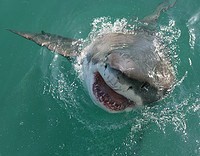
Great White Sharks Endangered


California’s Great White Sharks Under Attack


Sunny Magdaug and Patti Kishel hold the exclusive rights to the following copyrighted material. For permission to reprint or excerpt it and/or link it to another website, contact them at  
surfwriter.girls@gmail.com


These formidable predators – that can measure more than 20 feet in length and weigh over 5,000 pounds – with rows of saw-like teeth, have become the prey.


SurfWriter Girls Sunny Magdaug and Patti Kishel learned that the Northeast Pacific great white sharks are close to extinction, hunted for their fins (a delicacy in Asian soup), for meat to be used in fish cakes and fish and chips, or even as an ingredient in fertilizers.


A once-common inhabitant in the Pacific Ocean, environmentalists now estimate that fewer than 350 great white sharks can be found in California’s coastal waters.

The worldwide population of great white sharks is “less than the number of tigers,” says Dr. Ronald O’Dor, a senior scientist at the Census of Marine Life, based in Washington, D.C. Researchers have put the total number of great whites at somewhere between 800 and 2,500. 

Gene Rascon, West Coast Director of the non-profit marine conservation group PangeaSeed, explained that the goal of the group, which was founded in Japan, is to develop an understanding of the need to preserve and protect sharks and the oceans. 


Made up of scientists, artists, and ocean environmentalists, PangeaSeed uses multimedia tools to educate people and raise global awareness about the plight of sharks and the destruction of their habitat.


PangeaSeed warns that more than the great white sharks are at risk. Ninety percent of the ocean's big fish have already disappeared, coral reefs are dying and our seas are becoming plastic and toxic. The time is now to put on the brakes. 

Fishermen worldwide kill sharks mainly for their fins – a valuable bounty, that can sell for $700 a pound. The fins are used in preparing shark fin soup, a prized dish at Chinese banquets and weddings, often costing $100 a bowl.


The lucrative, virtually unregulated, global shark trade has already decimated many species of sharks, including hammerheads, oceanic white tip, blue, threshers, and the silky. Currently over 200 types of sharks are listed on the International Union for Conservation of Nature’s (IUCN) Red List as being threatened with extinction.


According to the Convention on International Trade in Endangered Species and the Food and Agriculture Organization of the United Nations:

 – More than 100 out of 400 shark species are being commercially exploited.

 – Many shark species are so over exploited their survival cannot be guaranteed.

– Monitoring and control programs are lacking in the international shark trade.

This is why it is so important for people to get involved in lobbying for government intervention to save the great white sharks.


PangeaSeed, in support of the Center for Biological Diversity and Oceana, the largest international organization focused solely on ocean conservation, and other environmental groups, recently submitted a petition to the National Oceanic and Atmospheric Administration (NOAA) – the federal agency that regulates fishing in U.S. waters – asking it to grant the great white shark protection under the Endangered Species Act.

It’s important for people to realize that safeguarding the great white shark does more than protect a species; it protects the marine ecosystem itself. Without the great white to fulfill its predatory role, serving as a check and balance on other marine life populations, such as elephant seals, additional species, including rockfish and salmon, will soon be at risk. 


SurfWriter Girls Sunny and Patti agree that we need to get the word out about this danger to the great white shark and the world’s marine ecosystems. This includes naming those countries that are participating in the “fin trade” by allowing the killing of sharks and the transport, export and import of their fins.


With over 100 countries involved in the fin trade, it’s a long list that includes mainland China, Hong Kong, Singapore, Malaysia, Taiwan and Thailand, according to the group Respect Our Seas. And, sad to say, among those names on the list are the United States and European Union, which both import significant quantities of shark fins for use in their local Chinese communities. 


Spain ranks number one among the 82 countries that export fins, sending them primarily to Hong Kong and other parts of Asia. Singapore and Taiwan are the number two and three exporters. The United Arab Emirates, which is in the fourth spot, also serves as a regional hub in the Middle East for the fin trade.


The global value of the shark fin trade is estimated to range from $540 million to $1.2 billion. The Food and Agriculture Organization of the United Nations reported in 2010 that, if people continue to consume seafood at unsustainable levels, many shark species will be extinct in the next two decades. In fact, if destructive fishing practices and pollution aren’t stopped, as well, the oceans’ entire fish population could be gone by the middle of the century.  

Most people don't realize how inhumane the shark fin trade is. In going after this prized commodity, fishermen skin the fins right off the living fish...


Shark fins drying in the sun

then toss the dismembered shark back into the ocean to die a slow and painful death...eventually suffocating or being eaten by other fish.


Along with directing public outcry at the countries that allow the great white shark trade to exist, another way to save the sharks is to restrict the use of gillnets in the fishing trade. 

 
Gillnets – gigantic mesh walls of death used to scoop up halibut, sword fish and sea bass – also entrap young great white sharks, thus depleting the future shark population. Known as “by catch,” these sharks are considered nothing more than collateral damage, a necessary part of the commercial fishing process.


Among the protections that PangeaSeed, the Center for Biological Diversity and Oceana are calling for are: safer fishing methods that limit the by catch of juvenile great white sharks, increased use of independent observers to monitor fishing catches, and the creation of protected areas for the great whites. 

 
Agreeing to these measures is in the best interests of the fishing industry because the great white sharks help to keep the fish population in balance, keeping the sea lions in check and other fish predators, as well.


SurfWriter Girls has found that when Industry and environmentalists work together to save endangered species, everyone benefits. This occurred recently in California when groups rallied to protect whales from collisions with cargo ships. To remedy this, the International Maritime Organization proposed shifting one of the shipping lanes in the Santa Barbara Channel 1.2 miles.


T.L. Garrett, vice president of the Pacific Merchants Shipping Association, said that the organization supported such a move, calling it “a common sense proposal based on good science.”

PangeaSeed believes that the destruction of our oceans and marine biodiversity is completely unnecessary and, in fact, morally wrong. It calls on nations to join forces and protect and preserve them for the health of the planet and ourselves.


One place to start is with the great white sharks.


You can check out the sharks for yourself at the International SurfingMuseum in Huntington Beach. It is holding a month-long PangeaSeed West Coast Surfing & Sharks Art Exhibition beginning Thursday, February 21, 2013.

SurfWriter Girls Sunny and Patti would like to thank Gene Rascon for all the information he provided us and the work he is doing with PangeaSeed to protect the Northeast Pacific great white sharks.


Please post your comment below. Comments will appear the next day.